DOC. MEERAE-TECH-06 · MEMBRANE CONTACTOR
CORE TECHNOLOGY · 06 OF 07
KO/EN
Home / Technology / 06 · Membrane Contactor
Tech06
Membrane Contactor · High-efficiency Ammonia Removal

MC.

Hydrophobic Membrane NH₃ Removal Up to 1,500 ppm TMCS
BriefA membrane-contactor system that recovers high-strength ammonia as hydrophilic ammonium sulfate. Handles influent up to 1,500 ppm.
Core Technology · 06 of 07

Membrane Contactor

Removal90 % (max 95%)
Inflowup to 1,500 ppm
TechTMCS Hydrophobic
Patent10-2390974

Overview.

SummaryA membrane-contactor system that recovers high-strength ammonia as hydrophilic ammonium sulfate. Handles influent up to 1,500 ppm.

Why Membrane Contactor

Not removal,
resource recovery.

High-strength ammonia wastewater is hard to treat biologically, and stripping is energy- and footprint-intensive. The membrane contactor operates near ambient temperature and pressure, recovering ammonium sulfate as a by-product and turning wastewater treatment into resource recovery.

Its modular configuration scales flexibly with changes in influent concentration and flow.

Key Features

  • →
    High-strength capable
    Treats influent up to 1,500 ppm
  • →
    Resource recovery
    Recovered as high-purity ammonium sulfate (NH₄)₂SO₄
  • →
    Low energy & footprint
    Less energy and space than stripping
  • →
    Modular
    Freely scalable capacity

Applications

Petrochemical · Semiconductor · Fertilizer · Landfill Leachate

Process Flow Diagram
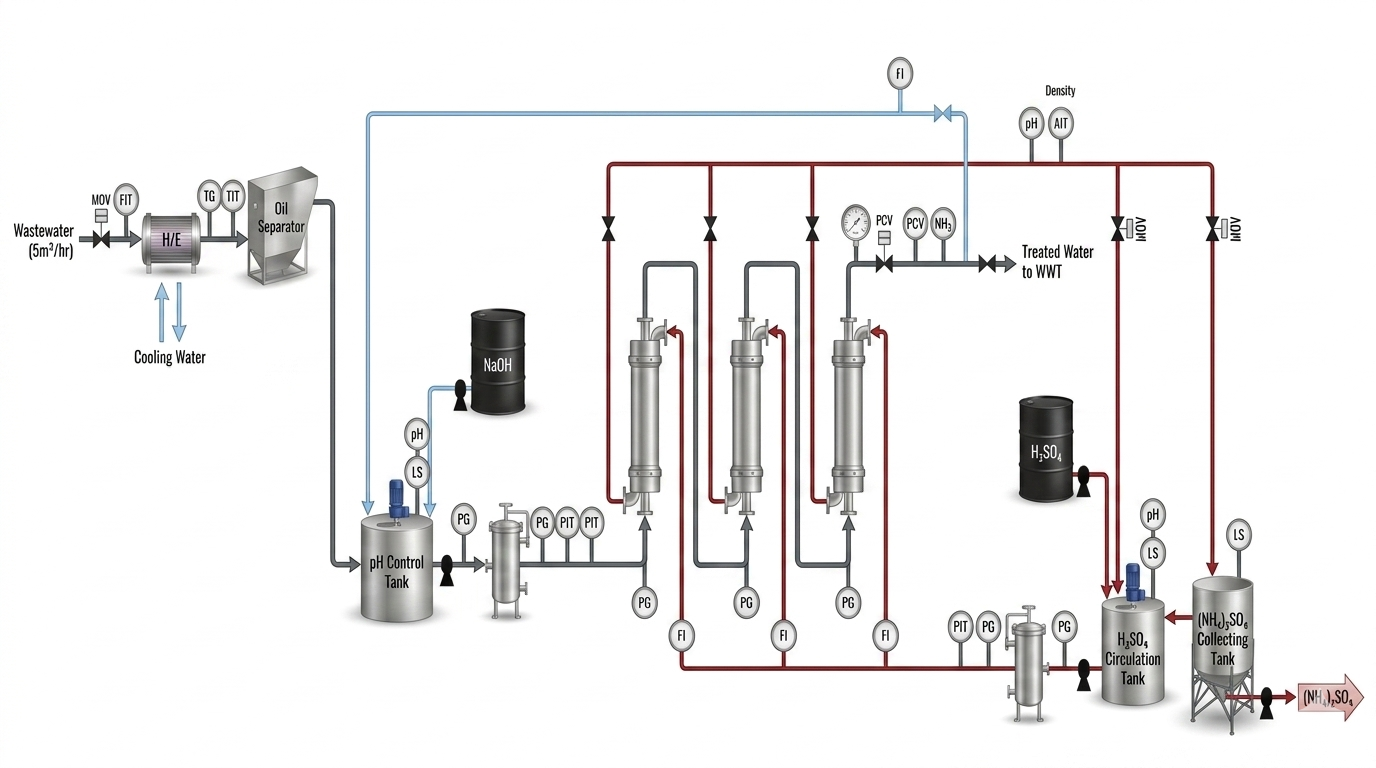
Membrane Contactor / MDG Process Diagram
FIG.01 Influent wastewater (5 m³/hr) is pretreated by an H/E + oil separator, then raised in pH with NaOH in the pH control tank to convert NH₃ to the gas phase. Passing through multi-stage hydrophobic membrane contactors (MDG/TMCS modules), only NH₃ permeates the membrane and is captured in the circulating H₂SO₄ absorbent on the far side, recovered as ammonium sulfate (NH₄)₂SO₄ in the collecting tank. Treated water returns to the WWT.
Back to Technology Index